EGPA
What is Eosinophilic Granulomatosis with Polyangiitis (EGPA)?
Eosinophilic Granulomatosis with Polyangiitis (EGPA) is a rare and complex disease associated with high levels of eosinophils, a type of white blood cell. It was first described by two pathologists, Jacob Churg and Lotte Strauss, in 1951. They reported 13 patients with asthma, eosinophilic vasculitis, and tissue granulomas. The disease caused damage to large blood vessels (arteries), medium-sized vessels, small vessels (arterioles), and veins. Subsequently, 30 patients were described in 1977 at the Mayo Clinic. These authors (Chumbley et al.) named the condition Churg-Strauss Syndrome. Only in recent years has it been renamed EGPA to avoid the use of individuals’ names.
EGPA is a rare disease, with prevalence estimates ranging from as low as 3 per million to as high as 20 per million people. It often presents very acutely, with patients going from good health to needing hospitalisation within days. Since it has a strong association with asthma, some patients are not diagnosed initially, as they are mistakenly diagnosed with severe asthma and receive systemic steroids, which also treats their EGPA, thereby delaying a correct diagnosis.
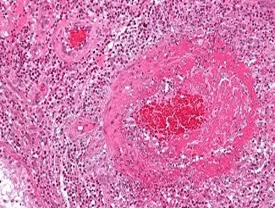
EGPA under the microscope
More severely affected patients are often very frightened and anxious, especially when the disease spreads beyond the lungs. This can include intestinal vasculitis, skin rashes, peripheral neuropathies, and heart disease. In the mid-1980s, life expectancy for this condition was less than five years. Fortunately, this has improved considerably, although it can still be a life-threatening disorder.
There are two subsets of this condition, which have been named relapsing and refractory. The relapsing group is the majority, involving around 70% of patients. Their disease may present acutely, but once treated with steroids (and other agents), it gradually diminishes and goes into remission. These patients may remain well for up to one to two years before experiencing another episode. When they relapse, they typically do so with the same clinical manifestations as in previous attacks. The refractory group is much more challenging, as repeated attempts to wean them off steroids fail, and they relapse and deteriorate unless steroid doses are increased. This group of patients is constantly at risk of severe morbidity or mortality as steroids are reduced—versus suffering the risks of staying on oral steroids long-term.
Steroids are clearly effective in treating EGPA. There is some data supporting the addition of cyclophosphamide (an immunosuppressive medication), and indirect evidence for using rituximab (a biological therapy). In recent years, anti-IL-5 therapies have shown some benefit in two clinical trials (Wechsler et al., NEJM). At the Lung Health Clinic, we have successfully managed nine patients with refractory EGPA using anti-IL-5 therapy administered over 3–9 years (total treatment duration: 66 patient-years), with only one documented relapse in that time.
EGPA is controversial in that it has been classified as an anti-neutrophil cytoplasmic antibody (ANCA)-associated vasculitis/autoimmune disease, but the evidence for this is limited. Published data suggest that only 30–40% of patients are ANCA-positive, and the two large clinical trials of anti-IL-5 therapy documented that fewer than 20% of patients were ANCA-positive. However, eosinophil levels are elevated in all patients, and histological data show eosinophils breaking down as they cross through blood vessel walls. It is therefore much more likely that this is a true eosinophil-led disease, and that the degranulation of eosinophils in blood vessel walls causes the vasculitis.
Thank you to Professor Philip Thompson, Director of the Lung Health Clinic, Hollywood Hospital and Emeritus Respiratory Physician, Sir Charles Gairdner Hospital (SCGH) for contributing this article.
Useful Links
American Partnership for Eosinophilic Disorders (APFED) - Eosinophilic Granulomatosis with Polyangiitis
Australasian Society of Clinical Immunology and Allergy (ASCIA) - Vasculitis DisordersAustralian and New Zealand Vasculitis Society (ANZVASC) - Vasculitis Types
EOS Aware - My EAD Stories
Rare Awareness Rare Education (RARE) Portal - Eosinophilic granulomatosis with polyangiitis (EGPA)
Vasculitis Foundation - Eosinophilic Granulomatosis with Polyangiitis
Page last modified: 25 July 2025